






Table of Contents
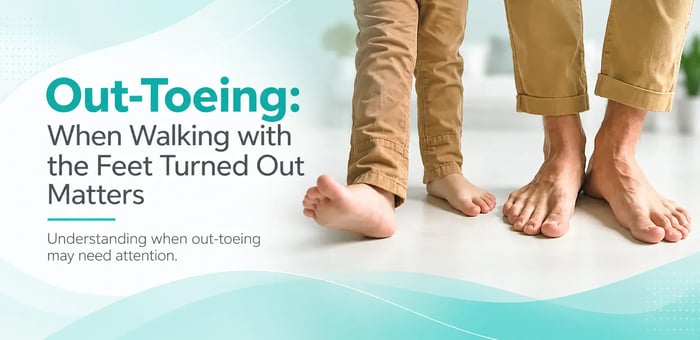
Out-toeing is a walking pattern in which the feet point outward during standing or walking. Some degree of outward foot progression is normal, however, persistent, pronounced, asymmetric, or symptomatic out-toeing may require further assessment.
Out-toeing can originate from different levels of the lower limb. Common contributors include external tibial torsion, femoral retroversion, and foot-related factors such as forefoot abduction associated with flatfoot. Therefore, simply observing the direction of the toes may not reveal the underlying cause.
How Can Flatfoot Contribute to Out-Toeing?
In flexible flatfoot, the medial arch lowers during weight-bearing and the foot may become more pronated, with forefoot abduction occurring as part of the overall foot alignment. These changes can influence the orientation and loading of the foot during walking and may contribute to an outward-facing foot position in some patients.
However, flatfoot is not the only cause of out-toeing. Rotational alignment of the tibia and femur can also play an important role. A comprehensive assessment is therefore needed to identify the factors contributing to each individual’s gait pattern.
When Can Out-Toeing Become a Problem?
Many children with out-toeing have no pain or functional limitations and may simply demonstrate normal developmental variation. However, when the gait pattern is accompanied by pain, instability, frequent falls, fatigue, or difficulty participating in physical activities, further assessment may be appropriate.
The foot progression angle can influence lower-limb biomechanics during walking. Research has demonstrated relationships between foot progression angle and plantar pressure, as well as changes in ankle mechanics during gait.
This does not mean that out-toeing inevitably causes knee, hip, or back problems. Its clinical significance depends on the underlying cause, severity, symptoms, and individual movement pattern.
How Is Out-Toeing Assessed?
Simply observing the feet can provide an initial indication, but it cannot determine the underlying cause. A proper assessment should examine the entire lower limb, including the hip, femur, tibia, ankle, and foot.
Clinical assessment may include the foot progression angle during walking, hip rotation, thigh-foot angle, tibial rotation, foot posture, joint range of motion, muscle function, and overall lower-limb alignment. This helps distinguish between different sources of out-toeing.
Imaging is not routinely necessary for every child but may be considered when a significant structural abnormality is suspected or further investigation is required.
When Is Treatment Necessary?
Treatment depends on the underlying cause, symptoms, and functional impact.
For children with normal developmental variation and no functional problems, observation may be appropriate because many rotational variations improve naturally with growth. Orthoses should not be used simply to correct rotational alignment of the femur or tibia, as they cannot change the structure of these long bones.
However, when out-toeing is associated with symptomatic flexible flatfoot or excessive pronation, foot-focused treatment may be considered. Custom foot orthoses can provide mechanical support and influence foot loading and lower-limb biomechanics. Recent evidence supports measurable biomechanical effects of foot orthoses in children with flexible flatfoot, although treatment should be individualized.
The PBS Approach
At PBS Orthotics Clinic, we believe that treating an unusual walking pattern begins with understanding where it comes from.
Our assessment looks beyond the position of the toes to evaluate foot posture, lower-limb alignment, joint mobility, muscle function, weight distribution, and gait mechanics. When flatfoot, excessive pronation, or forefoot alignment contributes to the gait pattern, personalized foot orthoses may be incorporated to provide appropriate support and optimize foot and lower-limb mechanics.
The goal is not simply to make the feet point straight, but to help each patient move with greater stability, comfort, and efficiency.
If you continue to experience persistent foot pain despite trying all natural treatment methods, consult a specialist promptly. At PBS, our team of foot care specialists provides services including custom orthotic insoles for plantar fasciitis and corrective devices for foot alignment. These solutions are personalized to treat the root cause and deliver the best possible outcomes.
Facebook: PBSofficial.TH
Line Official: @pbs.official
Source:
- https://posna.org/physician-education/study-guide/torsional-problems
- https://posna.org/blogs/resident-review/december-2017/pediatric-lower-extremity-disorders
- https://pubmed.ncbi.nlm.nih.gov/41883837
- https://pubmed.ncbi.nlm.nih.gov/24342455
Interested in insoles for flat feet or seeking professional advice on foot deformities, foot alignment, or office syndrome? Contact our experienced foot care specialists at: